myFICO - Credit Score Tracking
- 4.3
- Rating
- 1.00M
- Installs
- Free
- Price

 Analysis by App-foxy
When I want to understand whether my credit is moving in the right direction, I prefer seeing the information in one focused place rather than piecing it together from a bank app, an email, and a free score widget. That is the main reason myFICO caught my attention. It is a finance app from FICO that puts a FICO Score and an Equifax credit report at the center of the experience, with a clear purpose: helping me follow the credit information that can matter when I apply for cards, a mortgage, or a loan.
The important distinction is that this is not simply a general budgeting app. It is built around credit awareness. That makes it more useful for someone preparing for a major application than for a person who only wants to categorize everyday spending. In my experience, the app makes the most sense when I treat it as a monitoring and preparation tool, not as a magic button for improving a score.
Why the FICO Score focus matters
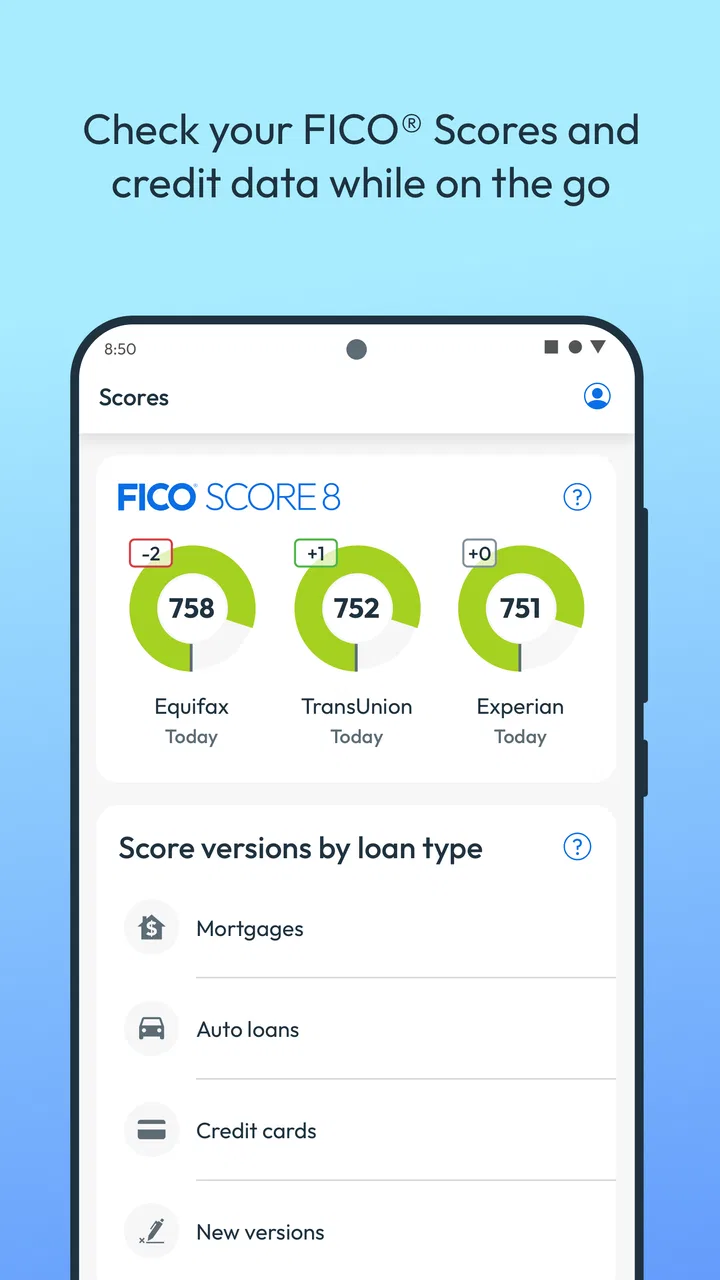
Many financial apps show a credit score, but the number is not always presented in the same way a lender may evaluate an application. The central appeal here is the focus on a FICO Score rather than treating every score as interchangeable. That gives the app a more specific role: it helps me become familiar with the type of credit measurement associated with lending decisions, while the Equifax report gives me the underlying account information to examine.
You May Also Like

 Blood Strike: 2.5 Anniversary
Blood Strike’s Loadouts Turn Every Drop Into a Tactical Gamble
A close look at Blood Strike’s custom loadouts: how fast access to signature weapons reshapes its battle royale rhythm, rewards preparation, and narrows the gap between fights.

 Pandora - Music & Podcasts
Pandora’s Music Is Easy to Start, but Harder to Recover
Pandora’s strength is its low-effort path from a seed to a station. Its weak spot is how much confidence it asks you to place in connection, setup, and quiet recovery.

 8 Ball Pool
 Is Built on Rivalries, Rematches, and Routine
A close look at the rivalries, rematches, shared routines, and unanswered safety questions that turn a quick pool match into a persistent mobile community.

 Samsung Music
’s Quiet Strength Is Playing What You Already Own
Its reach comes less from spectacle than from dependable access to a personal library. That simplicity is both the app’s strongest retention engine and its ceiling.

 AccuWeather: Weather Radar
AccuWeather Review: A Quick, Clear Forecast for Everyday Decisions
For everyday plans, the best forecast is the one you can understand quickly. AccuWeather makes rain timing, radar, and local conditions easy to act on, with a few trade-offs.

 Hill Climb Racing
Why Hill Climb Racing Still Turns Crashes Into One More Run
A tiny car, a bumpy hill and one more upgrade: Hill Climb Racing keeps resurfacing because its simple chaos makes every near-miss feel personal.
More From Our News Desk



That combination is more valuable than a score displayed without context. A number can look reassuring or alarming, but it does not tell me what accounts, balances, payment history, or inquiries are contributing to the picture. Reading the report alongside the score encourages a better habit: I can ask what changed, check whether the listed accounts look familiar, and decide whether I need to investigate something before submitting an application.
The real strength is the connection between the headline score and the report behind it. If I only check a score, I may notice movement without understanding it. If I only read a credit report, I may miss the broader signal that lenders commonly consider. The app is most useful when I use both views together and give myself enough time to react before I need new credit.
What the app is actually good at
I see myFICO as a way to reduce uncertainty. It can help me prepare for a conversation with a lender, review my credit position before shopping for a card, or keep an eye on whether a recently reported account appears as expected. It does not replace careful financial decisions, but it can make those decisions less dependent on guesswork.
The app is also a practical reminder that a credit score is not a permanent label. It can change as reported information changes. That is why checking the report matters more than celebrating a single high number. A score may be useful as a quick reference, while the report helps me identify the information that deserves attention.
For someone who has never looked closely at a credit report, the first session may feel more serious than opening a typical personal finance app. There is less emphasis on colorful spending summaries and more emphasis on records that can affect borrowing. I would not call that a weakness, but it does mean the app suits a particular mindset: I need to be willing to read carefully instead of expecting a one-tap financial diagnosis.
How I would use it before applying for credit
My preferred workflow would be to open the app well before a planned application, review the score, and then move through the Equifax report slowly. I would look for unfamiliar accounts, outdated information, and details that do not match my own records. If something seems wrong, discovering it early is far more useful than finding it while a lender is already reviewing an application.
I would also avoid treating a score change as proof that one action caused another. Credit reporting is more complicated than a simple progress bar. A lower balance, a new account, or a recently reported payment may affect what I see, but the app should be used to observe the record and understand its direction, not to promise an instant result.
A useful habit is to keep a personal note of the date I checked the report and the items I wanted to revisit. That makes the app part of a repeatable review process instead of an occasional source of anxiety. If I notice a detail that needs correction, I can gather statements or account information while it is still easy to find.
A realistic everyday scenario
Imagine I am considering a car loan later in the year. I have been paying my existing accounts, but I am not sure how the information currently appears to a lender. I open myFICO, check the FICO Score, and then read the Equifax report rather than stopping at the first number. I find an account I recognize but notice that its reported balance does not match my latest statement.
That discovery does not automatically solve the issue, but it changes my next step. I can compare the report with my records, contact the relevant company if necessary, and allow time for the information to be reviewed or updated before applying. Without the report, I might have walked into the loan process assuming everything was accurate because the score looked acceptable.
This is where the app earns its place for me. Its value is not that it makes borrowing effortless. Its value is that it can expose a question early enough for me to investigate it calmly. For a major financial decision, that preparation may matter more than checking the score repeatedly on the day I apply.
Reading the score without overreacting
One of the easiest mistakes is to treat every movement as an emergency. A score is useful, but it is not a complete explanation of my financial health. I would use the app to notice meaningful changes and then look at the report for clues, rather than making a sudden decision based on the number alone.
The opposite mistake is ignoring the report because the score seems fine. An unfamiliar entry can deserve attention even if the overall number has not changed in a way I notice. That is why I consider the report a working document, not background decoration. The score tells me to pay attention; the report gives me something concrete to examine.
Another practical point is timing. If I am planning a mortgage or another significant loan, I would not wait until the application is ready to begin checking. Credit information may require discussion or correction, and rushing removes the advantage of monitoring. The app works better as part of preparation than as a last-minute inspection.
Where it differs from ordinary free score apps
Free score apps often appeal to people who want a quick snapshot, general financial education, or alerts alongside other money tools. They can be convenient when I want a broad view of my finances. myFICO has a narrower identity. Its emphasis on the FICO Score and Equifax report makes it more appropriate when the question is specifically about credit readiness and report accuracy.
That focus is both the reason to choose it and the reason not to choose it. If I want bill reminders, a household budget, investment tracking, or a complete picture of spending, I would look elsewhere or use another app alongside it. This is not a replacement for a banking app or a budgeting system. It is a credit-focused companion.
The comparison also requires some care because different services may present different score models or bureau information. I would not assume that a number shown in another app must match the one here. Rather than viewing that as a contradiction, I would treat it as a reminder to check what kind of score and report each service is showing before comparing them.
The main trade-offs in daily use
The first trade-off is focus. I like that the app does not need to pretend it is an all-purpose money manager, but users expecting a full financial dashboard may find the experience limited. Its usefulness depends on having a credit question to answer. If I am not applying for credit, checking a report, or trying to understand my credit position, I may not open it often.
The second trade-off is emotional. Credit information can be stressful, especially when I see an entry I do not immediately understand. A focused report app gives me valuable detail, but detail also creates responsibility. I need to read carefully, keep records, and follow up through the proper channels when something looks wrong. The app can organize the information; it cannot make every dispute or correction simple.
The third trade-off is that monitoring does not equal improvement. Seeing a score does not itself raise it, and a report view cannot substitute for paying accounts on time, managing borrowing responsibly, or making decisions suited to my circumstances. I would be wary of any workflow that makes the score feel like a game with a guaranteed reward for checking more often.
I also think users should approach the app with realistic expectations about what a report can tell them. It is useful evidence, not a personal financial adviser. If I am making a complicated borrowing decision, I would still read the lender’s terms and ask qualified questions. The app can help me arrive better prepared, but it should not be my only source of judgment.
Who benefits most from this app
The strongest audience is someone preparing for a meaningful credit decision: a new card, a vehicle loan, a mortgage, or another situation where knowing the report in advance could prevent surprises. It is also a good fit for people who want to make credit monitoring a regular habit and prefer a product centered on FICO information rather than a broad collection of unrelated financial tools.
People rebuilding their credit may also find the report view useful because it gives them something specific to review over time. Instead of asking only whether the score is higher, they can watch whether the information being reported matches their actions. That encourages a more patient and accurate understanding of progress.
I would be less likely to recommend it to someone who only wants a simple spending tracker or a quick, casual estimate. That person may find a general finance app more convenient. I would also not choose it as my only financial app if I need a complete household budget, shared expense management, or investment monitoring. Its value comes from specialization, not breadth.
Practical details before installing
myFICO is free to install and is rated for Everyone, which makes it approachable for a wide range of users. It comes from FICO, the company whose name is closely associated with the score the app emphasizes. The app has been available since August 18, 2015, and its current version is 4.0.23.4, requiring iOS 12 or later.
Its reach also suggests that it is not an obscure experiment: the app has more than one million installs, with an average rating of 4.3 from around twelve thousand ratings and roughly four and a half thousand written reviews. I would read those figures as evidence of broad interest, not as a guarantee that every person will find the experience ideal. Credit needs vary, and a focused tool can be highly useful for one user while feeling unnecessary to another.
Before relying on any credit app, I would make sure I am comfortable entering a sensitive financial workflow on my phone and that I can recognize the difference between reviewing information and taking action based on it. I would also keep my own account statements available when checking the report. That small preparation makes it easier to spot discrepancies instead of relying on memory.
My recommendation after using it
I recommend myFICO to readers who want a focused way to follow a FICO Score and examine an Equifax credit report, especially before a major borrowing decision. Its best feature is not simply displaying a score; it is encouraging me to connect that score with the credit information behind it. That makes the app more useful for preparation, verification, and ongoing awareness than for casual financial browsing.
I would not install it expecting a budgeting suite or an instant credit-improvement plan. I would install it with a specific purpose: review my position, look for information that needs attention, and give myself time to act before applying for credit. Used that way, it offers a sensible balance between a quick score check and a more responsible look at the report.
My final view is positive but deliberately practical. The app cannot remove the complexity of credit, and its specialized focus will not suit everyone. For the right user, though, that focus is exactly what makes it worthwhile. If I were preparing for a loan or trying to understand my credit record more clearly, I would rather have this focused review tool than rely on a number with no surrounding context.
FAQs for myFICO - Credit Score Tracking
01What is myFICO – Credit Score Tracking used for?
myFICO is designed to help users monitor and understand their credit profile. The app provides access to FICO® Score information, credit report details, score changes, and alerts, depending on the plan selected. It can be useful for tracking financial progress, identifying possible inaccuracies, and preparing for major applications such as a loan, mortgage, or credit card.
02Does myFICO provide the same credit score that lenders use?
myFICO focuses on FICO® Scores, which are widely used by lenders, but there is no single score used for every financial decision. Different lenders may use different FICO® Score versions, credit bureau data, and lending criteria. Therefore, the score shown in the app can be a helpful reference, but it should not be treated as a guarantee of approval or identical to every score a lender may review.
03Is myFICO free to download and use?
The myFICO app may be free to download, but access to many of its main monitoring features generally depends on a paid subscription or purchased plan. Available benefits can vary, including the number of credit reports, score updates, bureau coverage, and identity monitoring tools. Before subscribing, review the current pricing, renewal terms, and included features displayed in the app or official store listing.
04How often does myFICO update credit scores and reports?
Update frequency depends on the myFICO product or subscription selected. Some plans offer regular access to updated FICO® Scores and credit reports, while other options may provide less frequent updates or single-report purchases. Credit information itself changes when lenders report new data to the credit bureaus, so an update in the app may not appear immediately after a payment or account change.
05Can myFICO help me improve my credit score?
myFICO can provide explanations, score factors, monitoring alerts, and educational information that may help you make better credit decisions, but it does not directly repair or increase your score. Improving credit usually requires consistent habits such as paying bills on time, keeping balances manageable, limiting unnecessary applications, and checking reports for errors. Any dispute or correction must be handled with the appropriate credit bureau or lender.
Pros
- Shows FICO Scores used by many lenders
- Provides score history to monitor changes over time
- Offers identity theft monitoring on eligible plans
- Includes personalized explanations for score changes
- Available on both Android and iOS devices
Cons
- Full access to multiple FICO Scores requires a paid plan
- Credit scores may update less often than your lender reports
- Some features vary depending on your subscription tier
- Can be expensive compared with free credit-monitoring apps
- Requires sensitive financial information and account permissions

myFICO - Credit Score Tracking
Gallery